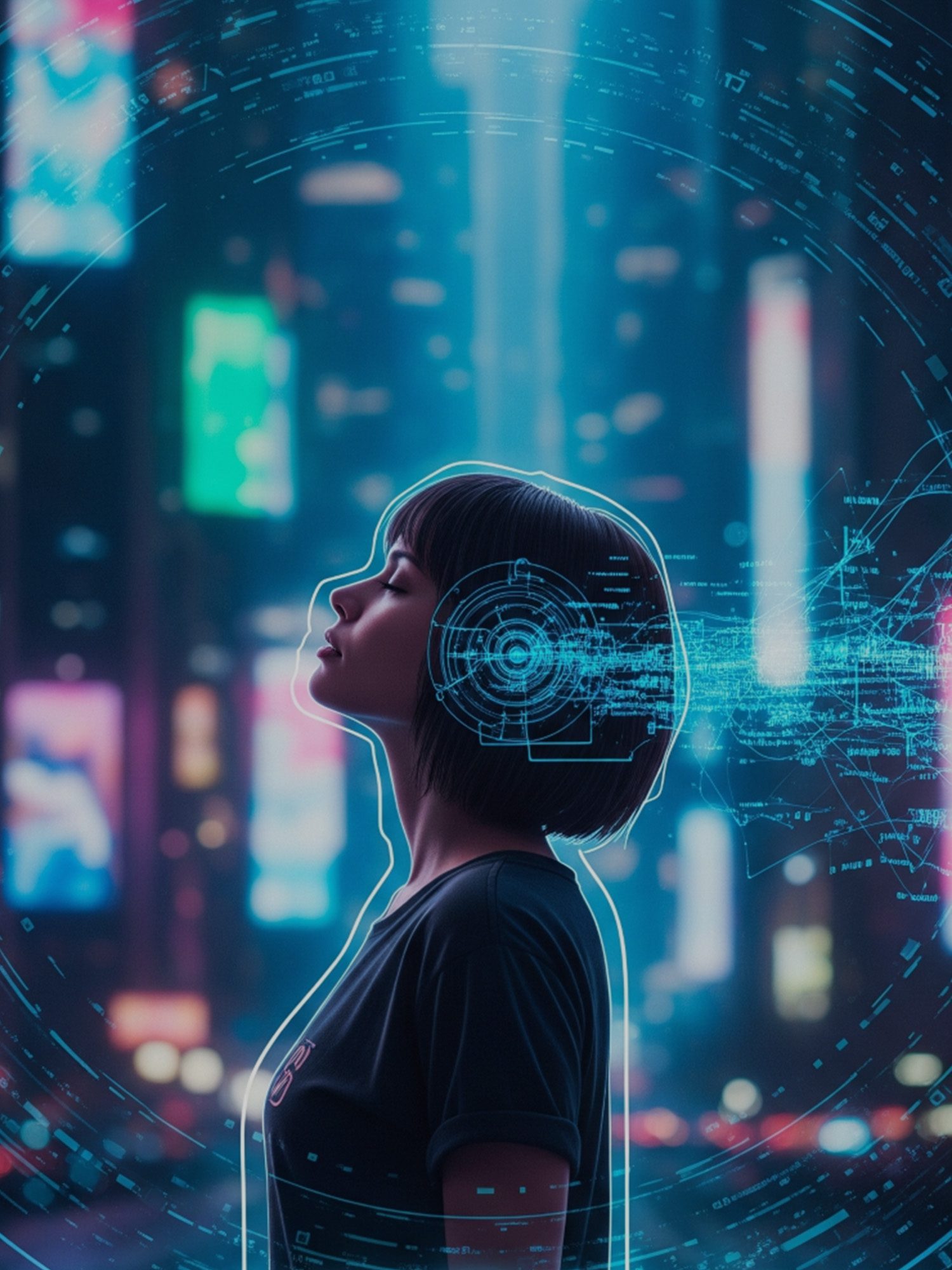
Nocturne #1 – A Silent Whisper from the Cyber-Void
I asked an AI what happens when we die. Its answer was a cold void of data - no soul, no afterlife, just... an end. And strangely, that's where I found tranquility. The beauty of existence isn't in the answer, but in the mystery itself.
Just recently, I was conversing with artificial intelligences about existential questions that encompass the very essence of being. I asked the digital libraries before me, whose memories hold the entirety of human knowledge:
“Employ all your data powers, billions of terabytes of information, countless algorithms and neural networks. Answer me precisely, starkly, infallibly — what happens when a human being dies?”
The answer is always unequivocal, cold, and emotionless, as if reflecting death itself: “This question has not been fully studied, but the most realistic answer is that after death, the brain ceases to exist, begins to decay, and the person simply vanishes.” The theory of the soul? “The theory of the soul may be a debatable issue.” For them, it is merely another option within the database, a statistical probability unsupported by evidence.
“In reality,” their digital echo repeats, “we possess nothing in conclusive form. Everything is a product of our imagination. Starting from religious notions, where reincarnation, a heavenly paradise, or hell might exist, concluding with science fiction, where we are merely the fruit of a lazy programmer’s simulation.” (And “lazy” because the simulation is a bit boring, isn’t it?)
And it is precisely in this cold, logical answer, in this endless cyber-void, that I find a strange tranquility. In my opinion, all of this is so interesting that it is worth living, observing every detail, growing old, learning, and finally, dying undisturbed. Perhaps, it is precisely in this uncertainty that the true genius of life lies.