
Where Words Just “Learn Themselves”
A personal digital lab for vocabulary building. Curate your own dictionary, play mini-games, and let help the words naturally stick in your memory.
Today, Artificial Intelligence is everywhere—it feeds you ready-made texts, translates articles, and builds dictionaries for you. At first glance, this is incredibly convenient. But when it comes to learning a foreign language or memorizing new words, this comfort becomes our biggest enemy. When the brain doesn’t make an effort, it simply doesn’t remember.
That is exactly why I created Memonatra—a vocabulary-learning web platform that partially defies modern, overcrowded AI trends. Here, the main character is you.
Manual Labor as the Ultimate Memory Tool
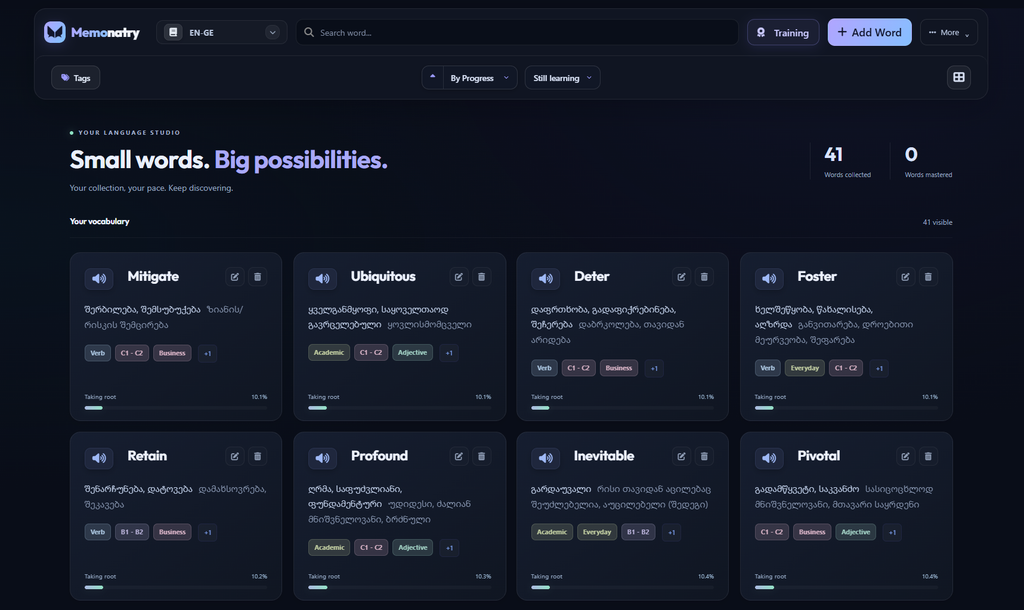
In Memonatra, you add the words yourself, translate them yourself, and curate your own dictionary. When you manually search for a word, type it out, and think about its meaning, your brain is already forming neural connections. Memonatra is built purely on this principle: you create your own personal space where you can learn a foreign language, memorize complex professional terms in your native language, or jot down short phrases.
When Laziness Takes Over (JSON and a Pinch of AI)
Even though the system relies heavily on your manual effort and engagement, sometimes we all get a little lazy. If that moment strikes, you can simply feed a JSON format to an AI and paste the results with a single click. This way, you can import the entire “philosophical essence” of a word, its context, and detailed explanations into the platform in seconds, without breaking the structure.

And for the truly lazy moments, the AI now lives right inside the app. Type a word into the glowing bar of the New Word window, add a wish if you like (“4 sentences, B2 level, business style”) and press Generate: translations, tags, example sentences and an explanation fill the card on their own. When you edit an existing word, the same bar turns into Improve: ask for two more sentences or a simpler explanation, or leave it empty and it will only fill in what is missing. But don’t get your hopes up: the AI is a guest here, not the host. It comes with a strictly limited daily allowance—just enough to rescue a tired evening, never enough to do your learning for you. The real work is still yours.

8 Games and the Magical 96%
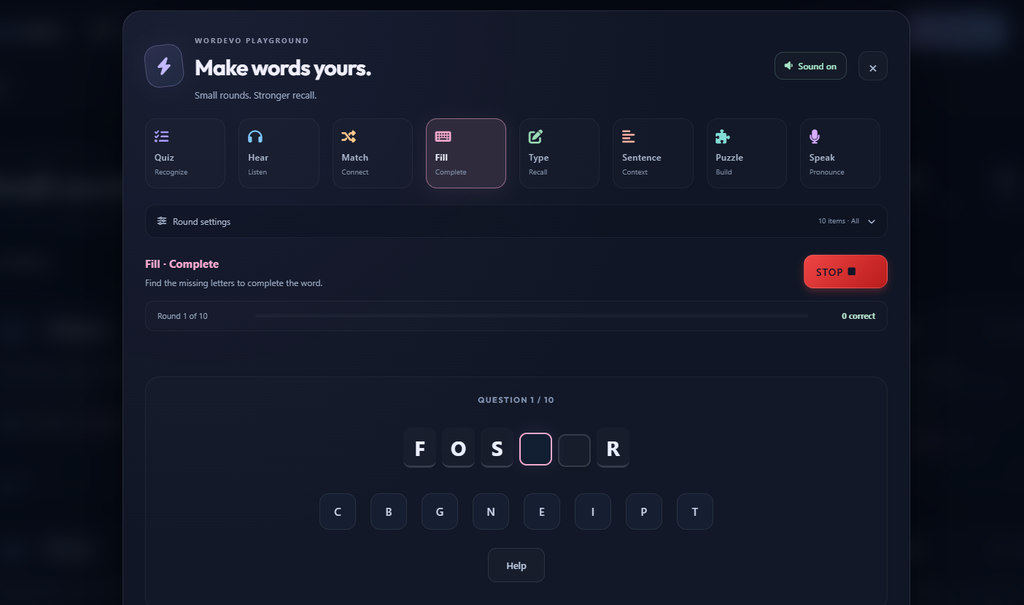
Learning shouldn’t be boring. The platform features 8 different built-in mini-games. Each manipulation and game increases a specific word’s “knowledge percentage.” When a word hits 96% in the system, it means it has successfully moved into your long-term memory and is now deeply familiar to you.
God Mode
Because the platform is maximally open and customizable, it features a built-in God Mode. This means you get to decide exactly how much percentage progress a specific manipulation or game should add to a word. The system has absolutely no limits—you can configure it so that simply opening a word instantly grants you 80%. But you have to be careful: God Mode can very easily turn into Stupid Mode. If you decide to cheat and artificially boost your percentages, you are ultimately only fooling yourself, and the platform loses nothing. The choice is yours—be a God, or take the Stupid route.
The “Accidental Learning” Phenomenon & Premium Voices
The Georgian language has a brilliant word—”შემომესწავლა” (shemomescavla)—which roughly translates to accidentally learning something without even trying. Memonatra’s biggest pride is its built-in audio player. You can sit in a bus or drive your car, turn on the player, and it will sequentially read your own custom dictionary to you. The technical flexibility here is top-tier: you can choose from Microsoft Azure‘s diverse database of natural voices, use Piper‘s local text-to-speech, or simply rely on your browser’s default TTS. You just listen, watch the road, and this listening process actually adds progress to your words in the system. Suddenly, you realize you just learned new vocabulary effortlessly.
Notifications for Those Who Prefer Music
If listening to music on the road is a sacred ritual for you, the app has a Notifications mode. You filter and select specific words, and the system sends them as push notifications to your phone throughout the day. This Spaced Repetition method forces your brain to instantly recall the meaning on the spot.

The Statistics Module
To help you know exactly where you stand and where you are going, the app includes a detailed statistics module that tracks practically everything. Here, you can see exactly how many words you’ve learned, which games help you the most, and how many words are eagerly waiting to hit that magical 96% mark.
One Account, a Whole Ecosystem
Memonatra no longer lives alone. It is part of a small ecosystem of my projects that share one account: sign in once with Google or email, and the same profile opens ReadRoad, my interactive books and Memonatra. Your dictionaries live in the cloud and follow you from the laptop to the phone, where Memonatra installs like a real app straight from the browser. The studio itself got a fresh, modern look—cleaner screens, your profile always at hand and smooth motion everywhere—so the lab finally looks as alive as the words inside it.
Step Into the Lab
Memonatra isn’t just a dictionary. It is your personal digital laboratory where you control what, when, and how you learn. If you want to experience the phenomenon of words just “learning themselves,” step into my lab and test the platform directly from the Projects page.